
Does bamboo fibre make a dog garment hypoallergenic?
No. A fibre source cannot guarantee that a finished garment will avoid an allergic or irritant response in every dog. “Hypoallergenic” reaches for a health outcome, and textile identity does not reach that far. What settles the question is evidence about the exact product and about the animals wearing it.
The word compresses several different questions. Is a particular dog allergic to a contact substance? Does a fabric hold substances above a named testing scheme’s limits? Does a seam rub? Is detergent left behind after washing? Does the garment fit without pressure? One fibre name cannot answer any of them.
The Merck Veterinary Manual’s overview of hypersensitivity diseases describes allergic contact hypersensitivity as a cell-mediated inflammatory and pruritic response to a sensitising substance in contact with skin. It notes reactions in dogs and gives contact chemicals in plastic collars and topical medicines as examples. It does not identify bamboo fabric as preventive or curative.
It helps to separate two kinds of language. Cosy clothing for a dog in an air-conditioned room describes how a garment gets used, and that is the register we write in. A medical property is a different order of statement altogether, and it carries a different order of evidence.
What can cause a problem when a dog wears clothing?
A dog can experience allergic contact disease, irritation or plain mechanical discomfort, and those are not interchangeable diagnoses. Contact substances, moisture, detergent residue, pressure and rubbing may each need consideration, but persistent skin signs need a veterinarian to identify the cause. Fibre marketing cannot work out which mechanism applies to an individual dog.
Merck explains that allergic contact hypersensitivity is associated with exposure to a sensitising chemical and can produce inflammation and itching. Its diagnostic discussion includes exposure history, distribution of lesions, exclusion of other causes and, where appropriate, histopathology or controlled challenge. That is a long way from picking a garment off a “sensitive skin” badge.
The Merck page on canine atopic dermatitis describes a chronic pruritic inflammatory skin disease. It says diagnosis is based on compatible history and clinical signs together with exclusion of other causes of itching. No retailer can use fabric language to collapse that diagnostic process into a universal product recommendation.
Mechanical discomfort needs a separate response. Our care guide tells an owner to take the garment off if it is wet, restrictive, rubbing, causing persistent scratching, or linked to unusual panting or distress. That does not diagnose an allergy. It reduces exposure while the owner checks the dog and seeks veterinary advice when signs persist.
What does OEKO-TEX Standard 100 actually test?
OEKO-TEX Standard 100 tests a certified textile article and its components against limits for more than 1,000 harmful substances. It uses four product classes based on intended skin contact. That is a harmful-substance certification scope, not proof that a textile prevents allergy or that every dog will tolerate a certified garment.
According to the official OEKO-TEX Standard 100 page, testing covers every thread, button and accessory in a certified article. The catalogue includes regulated and non-regulated substances, and OEKO-TEX says its limit values are reviewed at least once each year.
The scheme defines four product classes. Product Class 1 covers products for babies and has the strictest requirements. Product Class 2 covers products with direct skin contact. Product Class 3 covers products without direct skin contact, and Product Class 4 covers decoration materials. A class describes the testing framework. It is not a score of comfort or allergy prevention.
OEKO-TEX also states that a Standard 100 certificate is valid for one year. Its Label Check lets a buyer verify a label using the certificate or label number. A logo image by itself is not enough. The certified entity, article scope, product class and current validity all need to map to the exact item being sold.
Would a valid OEKO-TEX certificate prove allergy prevention?
No. A valid certificate would establish compliance with OEKO-TEX harmful-substance requirements for the certified scope during its validity period. It would not establish that no dog can react, that a garment treats dermatitis, or that its fibre is cooling, organic or environmentally preferable. Those are different claims with different evidence requirements.
This is a category error worth avoiding. Harmful-substance limits answer whether tested components meet a scheme’s thresholds. Allergic contact disease concerns an individual immune response to a sensitising substance. Irritation and rubbing can have other mechanisms entirely. Meeting the first standard does not erase the other two possibilities.
Nor can a certificate be borrowed from a supplier’s unrelated yarn or fabric. Certification scope may apply to fibre, yarn, fabric, dyeing, a facility or a finished article. A finished-garment claim needs a certificate whose product scope actually covers that garment, with a verifiable identifier and validity dates.
So when a logo appears, check it. OEKO-TEX runs a Label Check that takes a certificate or label number and returns the certified entity, the article scope and the validity dates. A logo printed on a page is a picture. The entry in the register is the fact, and only one of the two can be looked up.
How should clothing be introduced to a dog with skin concerns?
Choose by exact neck and chest measurement, introduce the garment for a short supervised period, and remove it if it becomes wet, restrictive or associated with rubbing, scratching or distress. Existing or persistent skin disease needs veterinary guidance. This handling approach does not make the garment hypoallergenic; it keeps observation separate from a medical promise.
Use our size guide rather than breed or weight alone. It shows where to measure the neck, the widest part of the chest and the back length. Two dogs at the same weight can take different sizes, which is exactly why a tape measure beats a guess.
Follow the sewn-in care label. Our care guide covers the rest. Rinse thoroughly, dry completely, and check the seams and the neck and leg openings before the garment goes back on. Detergent left in a fabric is a common source of irritation and an easy one to fix.
If a dog already has dermatitis, repeated itching, redness, broken skin, discharge or another concerning sign, the product page is not the diagnostic path. Merck’s veterinary guidance shows why history, clinical pattern and exclusion of other causes matter. A garment should not be marketed as a substitute for that assessment.
What would it take to support a hypoallergenic claim?
Quite a lot, and that is rather the point. The exact composition, disclosure of dyes and finishes, a certificate whose scope genuinely covers the finished garment, and evidence about how relevant animals responded. Each of those is a separate document, and none of them is implied by any of the others.
Indian advertising rules point the same way. Section 2(28) of India’s Consumer Protection Act 2019 covers false or misleading representations about a product’s nature, substance, quantity or quality. The ASCI Code requires claims capable of objective substantiation to be substantiated.
The word carries weight because of who reads it. Someone searching for help with a dog that has been scratching for weeks reads “hypoallergenic” as a promise, not as a texture note. That is why the evidence behind the word matters more here than it would behind a colour or a cut.
We make T-shirts and hoodies for indoor layering and sell them through Amazon India. Our Amazon buying guide keeps those commerce facts separate from material questions, because a sales channel settles delivery and returns. It does not settle dermatology.
What does this article not prove about bamboo textiles?
This article does not show that bamboo-derived fabric causes allergy, that cotton or synthetic fibres are safer, or that dogs should not wear clothing at all. It shows something narrower. Fibre origin cannot guarantee how an individual animal responds, and skin disease remains a question for a veterinarian.
It also does not rank OEKO-TEX against another certification. Standard 100 is a defined and verifiable harmful-substance testing scheme, and it is good at what it does. The limitation is one of scope. The scheme has never advertised itself as a universal canine allergy-prevention test.
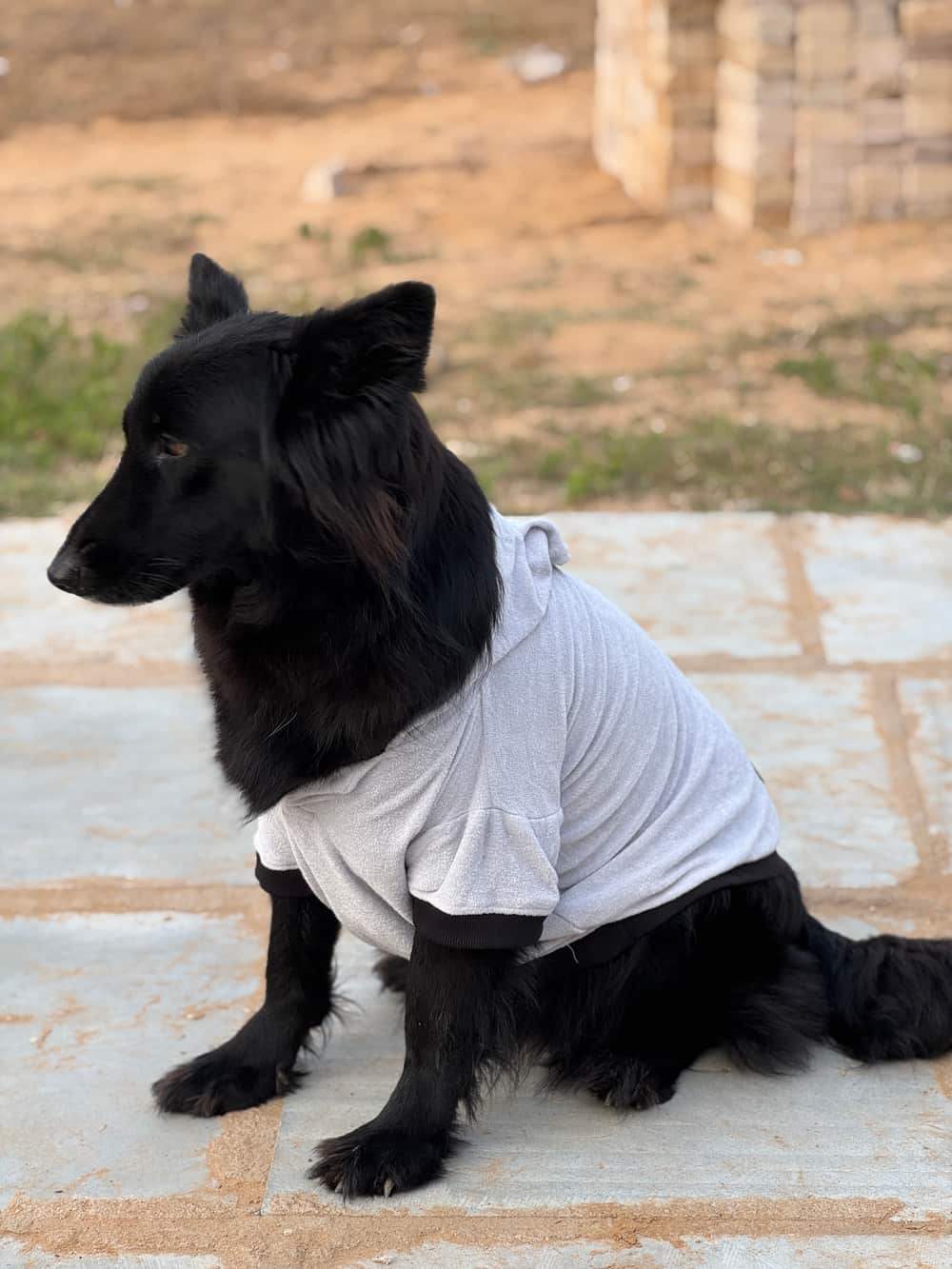
No inference should be made from the dog in the photographs. Images demonstrate appearance, colour and use, not dermatological tolerance. Alt text and captions follow the same rule as body copy and JSON-LD. They describe what is visible without inserting a medical property.
The honest conclusion is not that every textile is the same. It is that composition, construction, chemicals, fit, care and the individual dog all matter, and a broad “bamboo is hypoallergenic” shortcut hides every one of those variables behind a single friendly word.
Which factual claims and sources support this article?
Every objective statement above has a direct source. Merck supports the veterinary disease and diagnostic boundaries, OEKO-TEX supports the content and duration of its own certification, and the Indian sources support the advertising standard. Each row is a citation rather than a test result for any particular garment.
| Factual claim | Scope and source |
|---|---|
| Merck describes allergic contact hypersensitivity as a cell-mediated inflammatory and pruritic response to a sensitising contact substance. | Veterinary disease guidance: Merck Veterinary Manual |
| Merck describes canine atopic dermatitis as chronic, pruritic and inflammatory, with diagnosis requiring compatible findings and exclusion of other causes. | Veterinary diagnostic guidance: Merck Veterinary Manual |
| OEKO-TEX Standard 100 checks every component of a certified article against more than 1,000 harmful substances. | Certification scope: OEKO-TEX Standard 100 |
| OEKO-TEX Standard 100 has four product classes, with Product Class 1 using the strictest requirements. | Certification classes: OEKO-TEX Standard 100 |
| OEKO-TEX says its Standard 100 limit values are reviewed at least annually and a certificate is valid for one year. | Certification maintenance and validity: OEKO-TEX Standard 100 |
| Section 2(28) of India’s Consumer Protection Act 2019 defines misleading advertisement. | Indian statute: Government of India, Consumer Protection Act 2019 |
| The ASCI Code says objectively substantiable advertising claims should be substantiated. | Indian advertising code: Advertising Standards Council of India |